A key learnings report from Camp Tech

What drives AI adoption in Canadian small businesses?Here's what we learned teaching SMEs from coast to coast to coast.

Between April 2025 and April 2026, Camp Tech delivered two pilot programs designed to bring AI training to small businesses outside Canada's largest cities. This report shares our insights.

0+
Businesses trained across two programs
0+
Learners participated
0
Cities and towns reached
0
Provinces and territories

The two programs

What we built, and who we built it with.

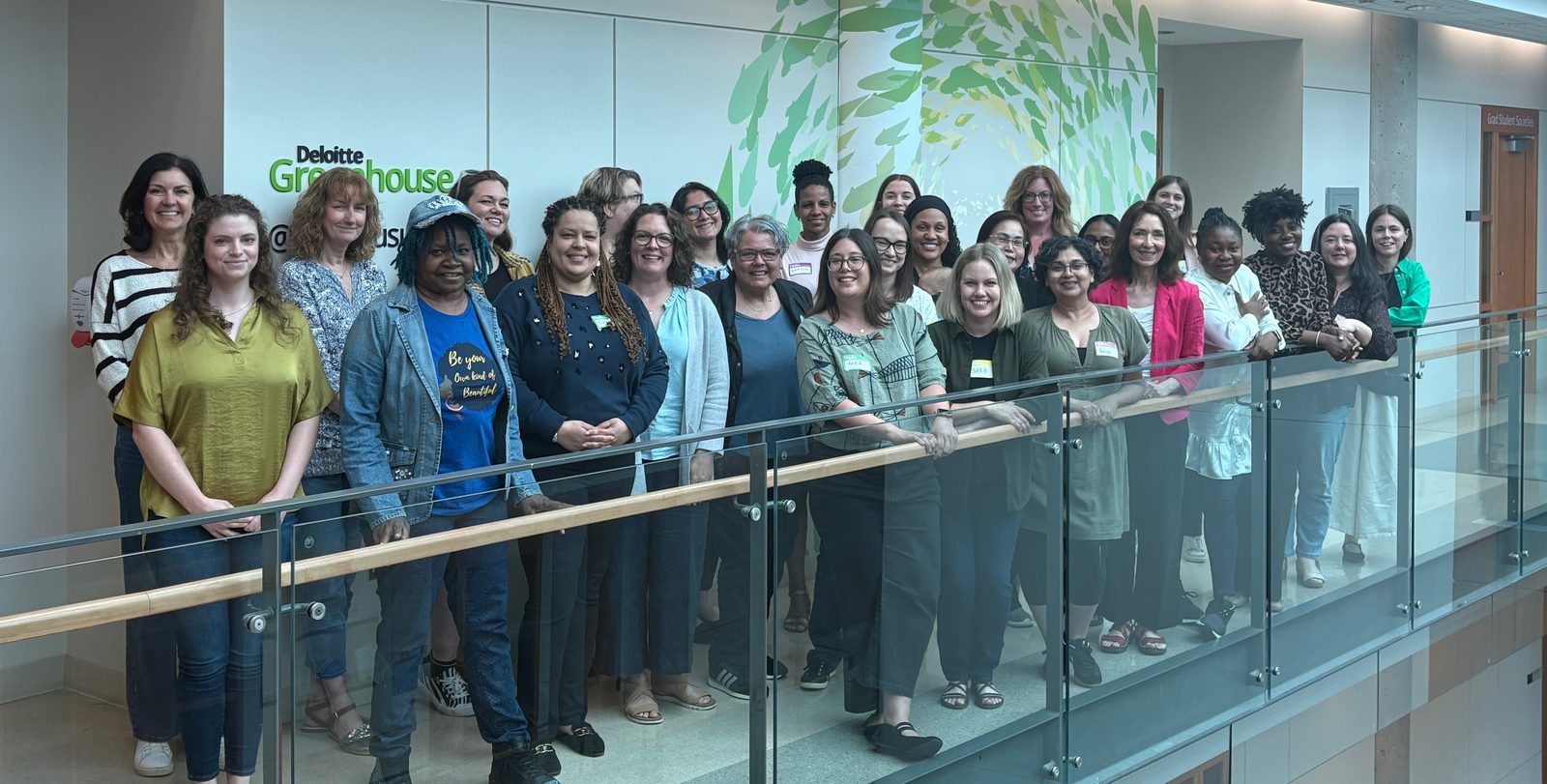
Participants at an Early AI Adoption Lab cohort gathered for a group photo

Early AI Adoption Lab

April 2025 — April 2026

148 participants across four cohorts

A national program supporting early stage women and non-binary entrepreneurs as they adopt AI into their businesses. Camp Tech designed and delivered the training in a variety of formats, and provided 1:1 mentorship. Entrepreneurs developed personalized 30-60-90 day roadmaps for their AI adoption.

The pilot ran across four cohorts:

  • North Bay, Ontario: fully in-person, six weeks
  • Halifax, Nova Scotia: fully in-person, five weeks
  • Live Online: fully virtual, six weeks
  • Whitehorse, Yukon: "new hybrid", five weeks

Partners & funders

Part of the AI Skills Lab Canada initiative, presented by The Forum, Camp Tech, and Growclass, with co-investment from DIGITAL, Canada's Global Innovation Cluster for digital technologies.
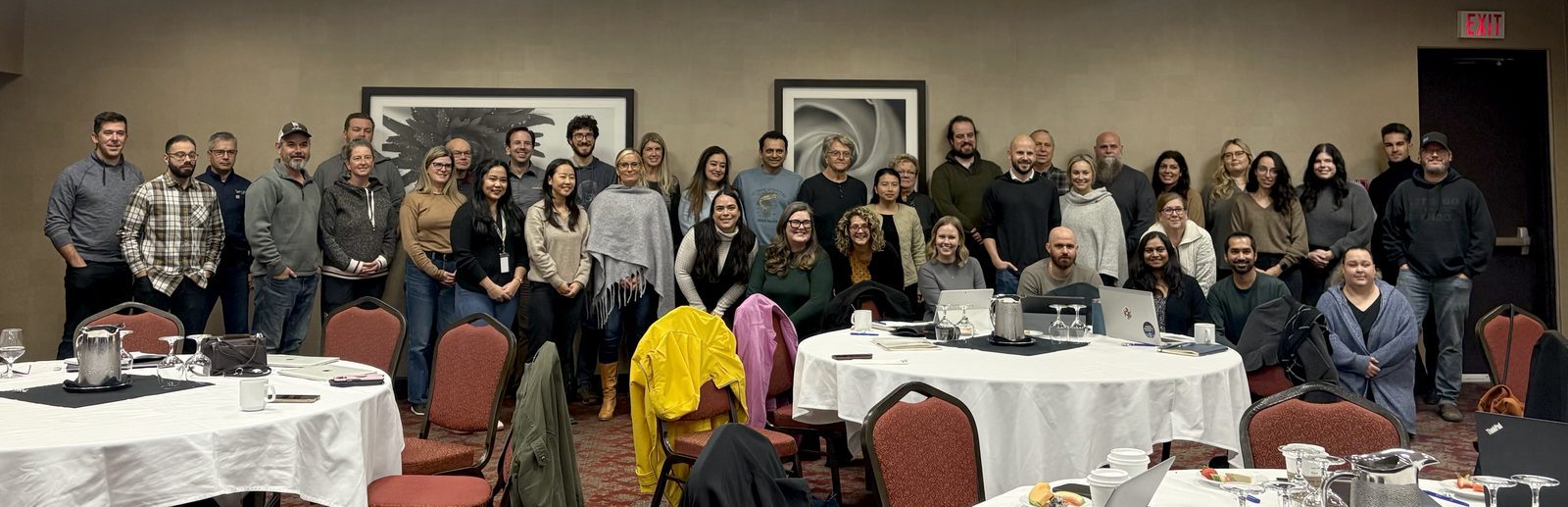
Participants at a Building Blueprints for AI Adoption workshop in Northern Ontario

Building Blueprints for AI Adoption

April 2025 — April 2027 (training delivered September 2025 — April 2026)

90 participants from 49 companies across two cohorts

The first AI adoption program of its kind built specifically for Northern Ontario SMEs. Camp Tech designed the content, delivered the training, and supported participants with 1:1 coaching. Every business that came through the program left with a customized AI adoption blueprint.

The pilot ran across two cohorts:

  • Sault Ste Marie, including Algoma and Manitoulin Island: "new hybrid", five weeks
  • Thunder Bay, including Dryden and Kenora: "new hybrid", five weeks

Partners & funders

Delivered through a partnership of Sault Ste Marie Innovation Centre, Northwestern Ontario Innovation Centre, and Camp Tech, with support from FedNor and the Government of Canada.

Where they came from

Participants joined from every corner of the country.

67 cities and towns, 9 provinces and territories. From Mayo in the Yukon to Sydney, Nova Scotia, and dozens of communities in between.

Where participants came from across Canada Loading map of Canada...

The starting hypothesis

The real barrier to AI adoption is not what you might think.

It isn't capability. It's confidence. Structured support is needed to move people from AI uncertainty to use.

Women entrepreneurs face a confidence gap, not a capability gap.

A Harvard Business School study of 17,000 entrepreneurs in Kenya invited participants to use ChatGPT with free access and instructions. Even with access equalized, women were around 13 percent less likely to engage with the tool. Deloitte's 2024 UK consumer survey found that 28 percent of women use generative AI compared to 43 percent of men.

Canadian rural and remote SMEs face a parallel gap.

The Toronto Metropolitan University Diversity Institute's 2025 report, Bridging the AI Gap in SMEs in Canada, states plainly that AI adoption is "not exclusively a technical challenge; it is also a skills and confidence challenge." The Canadian Chamber of Commerce's Prompting Productivity report found that urban businesses adopt generative AI at nearly double the rate of rural businesses (15 percent versus 8 percent).

What our own data confirms

Two very different audiences named the same problem in their own words.

Early AI Adoption Lab

At the start of the program, participants self-rated their confidence and knowledge. Across all four cohorts, every measure landed low.

Confidence in integrating AI
40–54%
Knowledge of selecting AI platforms
26–41%
Setting up AI systems and processes
26–37%

Building Blueprints for AI Adoption

We asked what's preventing Northern Ontario SMEs from using AI more effectively. It's not the cost of tools. It's confidence, not knowing where to start, and doubt that they can adopt AI safely.

Lack of internal skills or training
82%
Not sure where to start
49%
Concerns about accuracy or trust
47%
Cost of tools
27%

The mechanism that closes the gap is community, coaching, and confidence-building.

The Diversity Institute report specifically recommends solutions that combine "applied, accessible tools and strategies, ecosystem-wide support, and a focus on confidence-building alongside skill-building." Participants showed significant growth in both our programs, proving that training plus support is the recipe for success.

01

Key Learning:

Effective AI training has three strands, and they need to be woven through the entire program.

Fundamentals build the foundation. Use-case training meets people where they work. Leadership training sets the direction. These threads run in parallel, reinforce each other, and show up at different moments in the same program. Missing any one of them leaves the work incomplete.

Fundamentals

A grounded understanding of what generative AI actually is, and where to start with it.

  • How generative AI works
  • Basic prompting techniques
  • Hallucinations and bias
  • Intro to ethical AI use

Use-case training

Hands-on, scenario-based training that meets people in the work they actually do.

  • Admin, communications, operations
  • Marketing, sales, customer service
  • HR, finance, project management
  • Real exercises, real outputs

Leadership

Practical training for building an AI-forward culture that is aligned with organizational values.

  • AI use policies and disclosure
  • Data privacy and security
  • Risk and regulation
  • Values-aligned AI use

Where participants started, and where they ended up

This is the self-rated knowledge before and after participants took part in the North Bay (in-person) cohort of the Early AI Adoption Lab, on a 1-5 scale.

Ability to identify business areas for AI
2.4
4.1
+70%
Confidence in selecting AI platforms
1.9
3.7
+92%
Confidence in setting up AI systems & processes
1.9
3.5
+86%
Ability to navigate AI ethics & regulation
1.4
3.9
+189%
Where they started Where they ended
02

Key Learning:

Longer programs build habits, not just knowledge.

Successful AI training is a factor of both the total hours spent in workshops and the breathing room between sessions. It allows for participants to test their learning at work, hit something that doesn't behave the way they expected, and bring the question back to the next session. Confidence compounds over time, until the version of the person who finishes the program behaves meaningfully different from the version who started it.

Workshop Apply Roadblock Bring it back WEEK 1 WEEK 2 WEEK 3 WEEK 4 WEEK 5 WEEK 6

I valued the space and time carved out to experiment. Without the program, it would have been all too easy to deprioritize learning about AI in favour of more urgent tasks.

Virtual participant, Early AI Adoption Lab

We thought we knew what we needed going into the program, but our plan evolved substantially as we participated in the classes. We now expect to progress much further than we had initially anticipated with a new refined plan.

Sault Ste. Marie cohort participant, Building Blueprints for AI Adoption

03

Key Learning:

How the training is delivered matters as much as what is delivered.

The delivery format is instrumental in determining how a participant will fit AI training into their everyday lives. We tested three delivery formats across six cohorts:

In-person

In-person delivery is the strongest format for the benefits that come from being in the same room.

  • Spontaneous side conversations and hands-on support
  • Peer connections that turn a cohort into a network
  • Doesn't scale beyond the room

Virtual (live online)

Virtual delivery is the strongest format for reach and scale.

  • More accessible for participants juggling caregiving, business operations, or long geographic distances
  • Lacks spontaneous, in-the-room moments

"New hybrid"

"New hybrid" is built for cohorts that crave the connection of in-person and the practicality of online delivery.

  • The cohort is never split: everyone is in-person together for the first and last workshops, and live online together for the workshops in between
  • Works for rural and remote regions

Each delivery format has real strengths and real trade-offs. The right choice depends on who the learners are, where they are, and what outcomes matter most.

Feature In-person Virtual New hybrid
Quality training content
Spontaneous individual support
Peer-to-peer interaction
Scalability
Convenience
04

Key Learning:

One-to-one coaching is what participants told us they valued most.

Coaching closes the gap between "I learned this" and "I did this in my business this week." After every cohort wrapped up their group learning phase, participants were able to book 1:1 time with an AI coach to work through what they'd just learned and apply it to their own business. When we asked them what made the program resonate most, they named coaching.

0
Hours of 1:1 coaching delivered across both programs
0
Businesses who took advantage of coaching

We've come to think of coaching not as an extra layer on top of the curriculum, but as the thing that turns the curriculum into outcomes.

1:1 coaching made the course worth it. My business is a bit exceptional so the individualized support matters. I'm now thinking about automation and have a plan and a guide for implementing it.

Virtual participant, Early AI Adoption Lab

One on one coaching was instrumental in helping me identify how to integrate AI into my business. I'm more confident with the different ways I can use AI to save time and effort.

Halifax cohort participant, Early AI Adoption Lab

What it added up to

AI training that delivers results.

A program that builds confidence is only doing its job if that confidence translates into economic success. We asked participants what changed for their business after learning with Camp Tech.

From the Early AI Adoption Lab, six months after the program

0%
of graduates are actively using AI in their business six months on.
0%
have planned or launched a new product or service thanks to the program.
0%
of graduates said AI has made them more productive.

From Building Blueprints for AI Adoption, at the close of the program

0%
of graduates left the program with a defined AI project to pursue.
0%
asked to be contacted about implementing their AI project or pursuing funding.
0%
said their knowledge of AI tools improved through the training.

The thread that ran through all of it

We must meet people where they are.

That phrase is the core of how Camp Tech designs and delivers training, and we mean it on two levels at once.


We meet people where they are programmatically. Every cohort is shaped by the geography, the sectors, and the lived realities of the learners we're working with. The questions a fishmonger in Halifax brings to a session are not the same questions a manufacturer in Thunder Bay brings, and we build for that difference rather than around it.


And we meet people where they are literally. In their towns, in online rooms together, in the places where learning still does its best work. The findings above are what that approach taught us, and the framework that follows is what we're building next from those lessons.

Looking ahead: a new framework

The AI Adoption Atlas.

We had a front-row seat watching over 200 businesses move through AI adoption in real time. We saw what changes from week one to week six. We saw the moments when curiosity tipped into commitment, when one-off tool use turned into integrated workflows, and when individual experimentation started to look like organizational strategy. The Atlas is the framework we built from what we saw.

The five stages

Stage 01

Awareness

"We see the potential."
Stage 02

Experimentation

"We're trying things out."
Stage 03

Integration

"AI is part of how we work."
Stage 04

Strategic Deployment

"AI is driving our growth."
Stage 05

Organizational Scaling

"It's how we operate."

Measured across seven dimensions

Frequency & Depth

How often AI tools are used, and across how many business functions.

Business Outcomes

Time saved, revenue growth, quality lift, customer satisfaction.

Skill Sophistication

From basic prompting to custom-built AI applications.

Jobs & Employment

Roles created, retained, or upskilled through AI adoption.

Workflow Integration

Whether AI is a side tool or a standard part of business processes.

Governance & Risk

Data privacy, compliance, quality controls, ethical use.

Organizational Spread

How widely AI knowledge and use extends across the team.

Looking ahead

The AI Adoption Atlas is a framework we've fully built out. The next step is putting it to work, and the reach widens as it goes:

01

At intake

A diagnostic from day one that shapes how we teach each business.

02

Through the program

A measure of movement, not just a snapshot of where someone ended up.

03

Across cohorts

A benchmark for AI adoption across regions, sectors, and program designs.

04

As policy infrastructure

Evidence for the bigger conversations about how to invest in AI adoption at scale.

Work with us

Want to know more about these programs and what Camp Tech can do?

Reach out to Avery Swartz, Camp Tech's founder, to learn more about what we built, what we learned, and what we can build together. We work with funders, agencies, and organizations across Canada to design AI training that meets people where they are.

Email Avery